SDS Authoring & Maintenance subscription
Stay ahead of the curve with WHS Monitors’ SDS Authoring & Maintenance subscription

WHS Monitor caters for all businesses with plans to suit any size.
WHS Monitor is not limited to private companies
WHS Monitor is flexible enough to provide end-to-end compliance solutions for every industry.
WHS Monitor is a flexible software that can be used for any number of compliance related functions
The Essential Safety Package is designed for SMB organisations up to 50 people.
The Full Compliance package is designed for organisations larger that 50 people, or organisations with detailed compliance requirements.
A standalone chemical management solution that can take care of your chemical inventory and chemical risk compliance
WHS Monitor offer a range of services to get you compliant sooner and stay compliant longer.
Read how WHS Monitor solutions solve compliance for a diverse range of businesses
Stay ahead of the curve with WHS Monitors’ SDS Authoring & Maintenance subscription





To ensure that your Australian and/or New Zealand SDS remain in compliance, you need to stay informed about updates in chemical hazard classification, including monitoring of each ingredient against:
You also need to regularly review your SDS and update them as needed to reflect any GHS-related changes in chemical classifications and safety data.
Fines for non-compliance range from $7,700 to $37,950 per breach
Optional with system license:

A WHS Monitor safety specialist will contact you to assess your needs.
*Fields marked with an asterisk are compulsory
Monitoring of each ingredient against National (Safework Australia) and International GHS changes, Poison Schedule classification changes, Carcinogens classification changes, ADG classification changes, and Industry publications to notify:
1. Ingredient changes – monitoring of affected products
2. Threshold changes – review of the thresholds
Unlimited non-technical changes such as the updating of contact information or branding and logos
Correction / update of SDS to the new requirements and re-issue (compliant for 5 years) at 50% discount off the normal cost of SDS.
Addition of your product into the WHS Monitor database to be maintained and accessible by WHS Monitor users
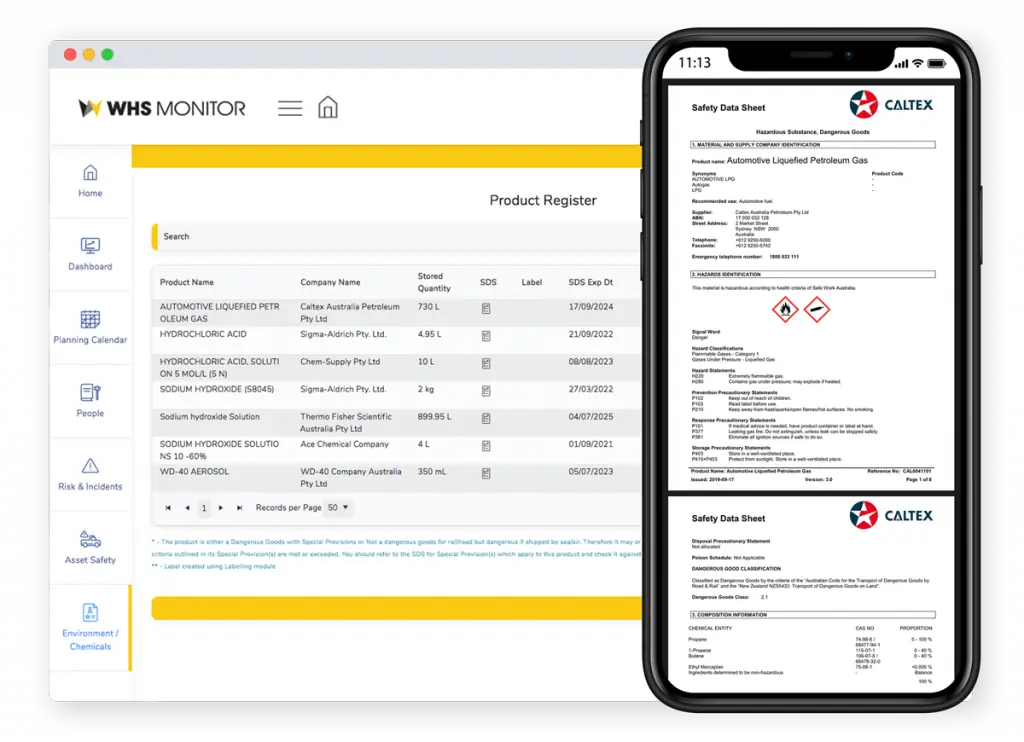
WHS Monitor’s cloud-based risk and compliance management software also contains the most comprehensive chemical management module available. It can automatically generate compliance reporting of any stored chemicals, including chemical volumes as well as segregation between hazardous chemicals.
Legislation about the importation, manufacture and storage of industrial chemicals is changing rapidly. Please refer to the AICIS website for more information
The AICIS define industrial use by exclusion. This means that an industrial use is any use that isn’t:
An important note about use is that a chemical can have multiple types of uses. For each use your chemical has, you need to follow the regulations for each responsible regulator.
This is a declaration you make about the industrial chemicals you imported or manufactured during the previous registration year. It’s an opportunity to confirm that your introductions were authorised under our laws.
Who must submit an annual declaration
The registered importer or manufacturer who introduced the chemicals during the previous registration year must submit the annual declaration.
What information do I submit?
Your annual declaration will include:
Note: Your first annual declaration is due by 30 November 2021 and covers the period from 1 July 2020 to 31 August 2021.
This refers to the AICIS registration of a business that imports industrial chemicals into Australia or locally manufactures industrial chemicals (referred to as an ‘introducer’). You register by completing an online form and paying a fee.
You register your business, not your products or chemicals.
You must register your business with AICIS before you import or manufacture (‘introduce’) industrial chemicals for any of the following:
• Import industrial chemicals, or products that release industrial chemicals into Australia
• Import finished and packaged products that release industrial chemicals – for example, labelled cosmetic products (soap, shampoo, lotion), paint, glues, engine oil and pens
• Import industrial chemicals and reformulate in Australia
• Manufacture industrial chemicals in Australia
The Australian Inventory of Industrial Chemicals (Inventory) is a database of chemicals available for industrial use in Australia and it has a legal purpose. It contains chemical identity details (for example, the chemical name and molecular formula) and regulatory obligations or conditions relating to the importation and manufacture of chemicals in Australia.
Who must use the Inventory?
If you’re planning to import or manufacture (introduce) an industrial chemical, or a product that releases industrial chemicals, you must register your business with us and search the Australian Inventory of Industrial Chemicals (Inventory) through our website.
What do you need to know before you search the Inventory?
You must search for each industrial chemical ingredient separately if you are introducing a product that has more than 1 industrial chemical. If you find your chemical is listed, you need to check if we’ve added any specific regulatory obligations or restrictions on the chemical.
What you must submit
You’ll need to submit an annual declaration at the end of each AICIS registration year – some time between August and 30 November.
Why you must keep records
You must keep certain records about your chemical introductions to confirm they are authorised. You must keep these records for 5 years, even after you’ve stopped introducing your chemical.
There are different requirements for registration, depending on:
It’s important to know that many cosmetic ingredients sourced from overseas are described as ‘natural’ or ‘organic’ – such as oils, extracts and plant essences – but they may be regulated as industrial chemicals.
And many products composed of natural or organic ingredients – such as polyurethanes and essential oils – are made using a process that involves a chemical reaction.
You must register with AICIS if you make products to sell using industrial chemicals that you’ve bought from an overseas supplier.
You do not need to register with AICIS if you make products to sell using 100% locally sourced ingredients – as long as the manufacturing process does not produce a chemical reaction or create more industrial chemicals as a result.
You register your business with us, not your products or ingredients.
What is blending
Blending is commonly described as the process of mixing two or more chemicals together without producing a chemical reaction or creating more industrial chemicals as a result. Many consumer and cosmetic products containing industrial chemicals are mixtures formed by blending.
You don’t need to be registered with AICIS to blend industrial chemicals, as long as the ingredients are purchased from an Australian supplier.
If a chemical reaction does occur and more industrial chemicals are created as a result, it’s defined as manufacturing. You must register with AICIS to manufacture industrial chemicals.
And if you import industrial chemicals or products that release industrial chemicals from overseas for commercial blending in Australia, then you must register with us.
Consumer and cosmetic products that are mixtures of industrial chemicals still need to comply with other Australian legal requirements for labelling and consumer safety.
What is manufacturing
If you mix industrial chemicals (or products containing chemicals) together and it results in a chemical reaction that produces more industrial chemicals, then this is defined as manufacturing under the Industrial Chemicals Act 2019. If your manufacturing is for a commercial purpose, then you must register with us.
Examples of manufacturing chemicals
